

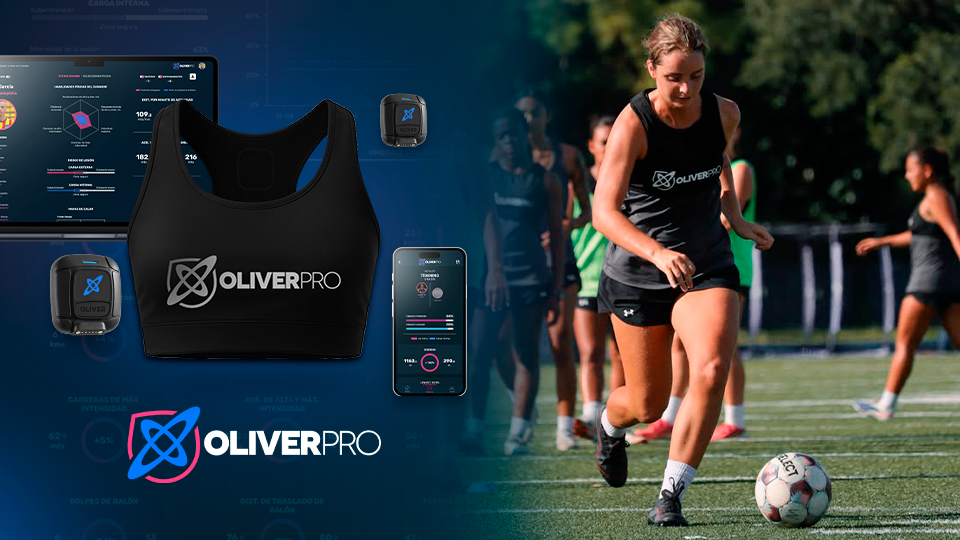
For a football academy, the best GPS platform is one that combines reliable metrics with a platform that coaches without an analyst background can use easily, and that lets you track many players across different age groups without complicating logistics. OLIVER PRO is designed for exactly that profile: it works indoors and outdoors, interprets the data with artificial intelligence, and is used by more than 400 teams in over 50 countries, including academies such as Real Racing Club's.
In this guide, we look at what a GPS platform for youth football should offer and which metrics matter.
What should a GPS platform for a football academy offer?
An academy has different needs from a professional first team: more players, several age groups, coaches who don't always have time to analyse data and, often, different training venues. That's why it pays to evaluate six criteria:
- Reliable, football-specific metrics: distance, speed, sprints, accelerations, decelerations and ball metrics.
- Ease of use: a coach without data analysis training should be able to read the results and make decisions.
- Scales across age groups: it should be practical to equip and manage players of different ages.
- Quick setup: switching on and handing out the devices shouldn't eat into training time.
- No fixed infrastructure: it should work on any pitch or in any sports hall without installing antennas.
- Long-term tracking: a history for each player to follow their development season after season.
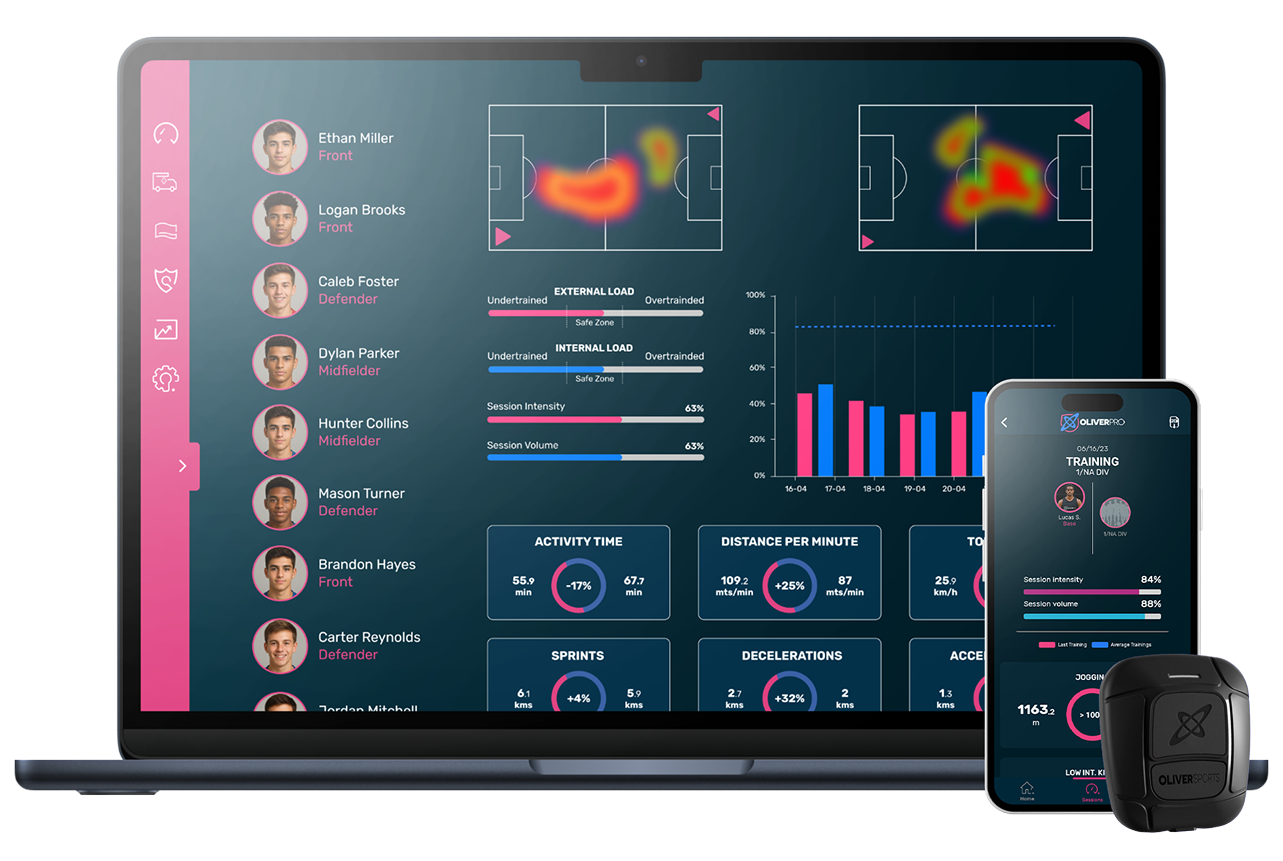 OLIVER PRO: GPS platform for teams, academies and clubs
Which GPS metrics matter in youth football?
In an academy, the goal isn't just to measure performance, but to support each player's development and manage load according to their age and stage. The most useful metrics are:
- Total and relative distance: the volume of work in each session.
- Top speed and sprints: how a player's speed develops over the course of their training.
- Accelerations and decelerations: the explosive actions that put the most load on a player.
- Metabolic power: estimates energy demand, including the cost of accelerating, which makes it useful even in small-sided drills.
- Heatmap and analysis by half: in outdoor matches, the platform shows where each player played and automatically splits the two halves.
- Personal speed zones: on top of the fixed zones, each player has zones based on their own top speed, and each club can set up its own. This makes it possible to compare the effort of players of different ages and positions relative to their own capacity.
- Volume and intensity of each session: calculated against the player's own history, to see how much they worked compared with their capacity rather than a generic benchmark.
- Ball metrics: with the device worn on the leg, actions such as shot power and kicks by intensity.
- Session load and history: to compare training sessions and matches and see how each player progresses.
A platform like OLIVER PRO records more than 200 variables, but in youth football what matters is choosing the right ones carefully: the ones that answer the question you want to solve for each age group.
Why is OLIVER PRO a good fit for football academies?
- AI-interpreted data: an assistant answers questions in natural language, such as "Which U16 players did the fewest sprints this week?", and the platform generates reports for every session and recommendations for each player based on their load history.
- Built for many age groups: the Smart Case switches the whole squad's devices on and off with a single button and charges them by contact, ready for the next group.
- Outdoors and indoors: the same device measures with GPS on the pitch and with its inertial sensors in the sports hall, with no antennas or infrastructure.
- Ball metrics: worn in the sock, it measures technical actions such as shot power and dribbling.
- Per-minute metrics and drill tagging: to analyse each drill separately, not just the full session.
- Multi-sport: if the club has other sections, it also works for futsal, basketball, handball, rugby, hockey and volleyball.
OLIVER PRO's GPS is also used in academic research, such as this study by the University of Málaga on internal and external load in a professional women's football team.
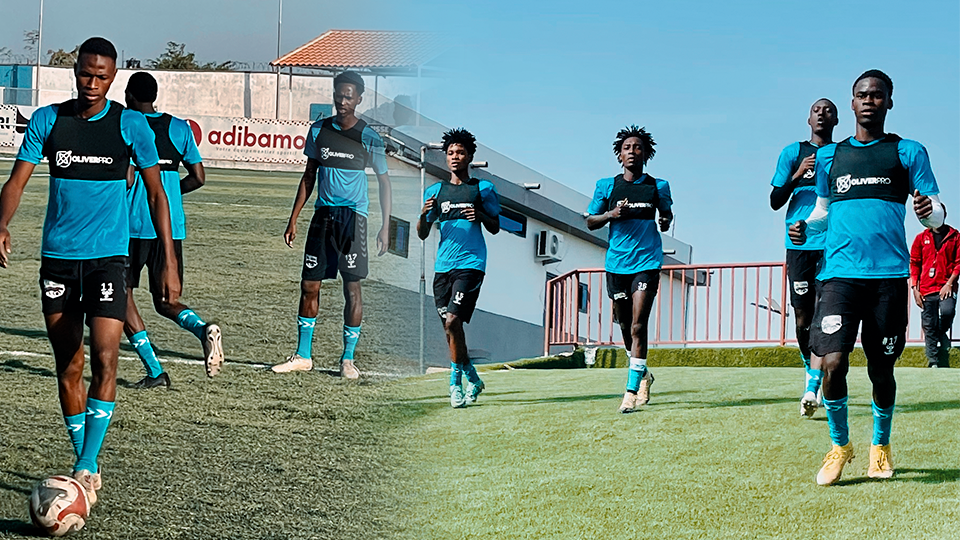
The right choice depends on how the academy is structured. Platforms built for elite performance usually require a team of analysts and a first-team budget to get the most out of them. For most academies, what makes the difference is getting data that's already interpreted and a system that's simple to run day to day. OLIVER PRO is designed precisely for that profile: artificial intelligence interprets the data for the coach, it doesn't require antennas or infrastructure, and it adapts to academies of any size.
How to get started with GPS in a football academy
- Start with one or two age groups, usually the oldest, where load and competition are most demanding.
- Define a few key metrics for each age group, based on the goals of each stage.
- Build your own benchmarks by age and position, rather than copying values from professional teams.
- Share the data with coaches in a simple format, so it becomes part of weekly planning.
- Expand to the other age groups once the process is established.
Academies and clubs already using OLIVER PRO
OLIVER PRO is used by more than 400 teams in over 50 countries, from academies and semi-professional clubs to the youth systems of historic clubs. Real Racing Club, for example, uses it to digitise how it tracks its youth teams. See how it uses it in its academy.
Want to equip your academy with OLIVER PRO?